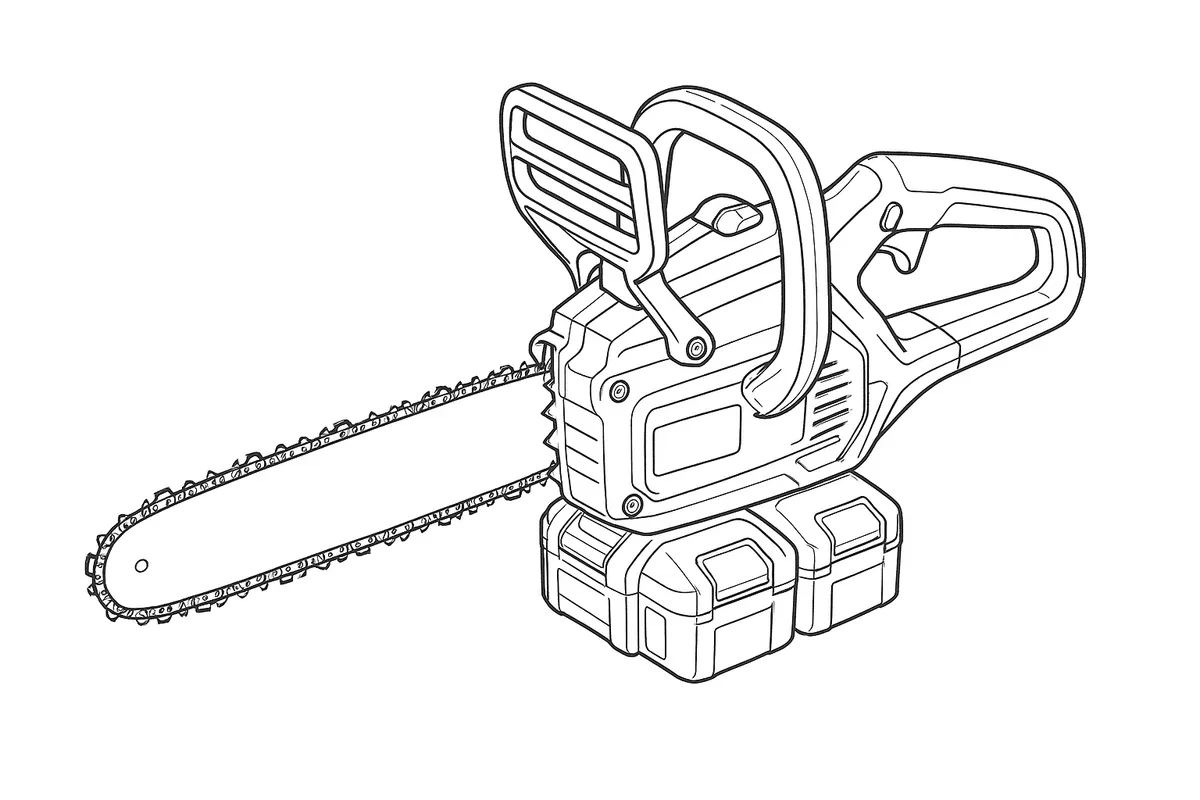
The symptom pattern
Battery’s in, trigger’s being pulled, and the saw does precisely nothing. It’s easy to read that as the chainsaw itself having failed, but the DUC302 is built with several separate conditions that all have to be satisfied before it will run — and on a cordless chainsaw, most “won’t start” reports turn out to be one of those rather than a genuine fault.
What’s actually happening
Makita’s own trouble-shooting table lists “chain saw does not start” with two causes: two battery cartridges not installed, and battery undervoltage. The DUC302 is a 36V tool built from two 18V LXT packs, and the manual is explicit that “the tool does not work with only one battery cartridge” — fit only one and, by design, nothing happens.
The chain brake is the cause that isn’t in that table at all, but is given its own direct instruction elsewhere in the manual: “If the chain saw fails to start, the chain brake must be released. Pull the front hand guard backwards firmly until you feel it engage.” An engaged front hand guard is a common reason a saw refuses to start after being set down or carried with the guard nudged forward.
Then there’s the start sequence itself. The DUC302 has a lock-off button on top of the handle that has to be pressed before the switch trigger will do anything — the manual’s own instruction is “depress the lock-off button and pull the switch trigger,” in that order. Pulling the trigger on its own achieves nothing, which is exactly the “it’s dead” moment that leads people to suspect a fault that isn’t there.
The other silent cause is the tool/battery protection system. If the tool or a battery has overheated, Makita states plainly that “the tool does not start even if pulling the switch trigger” — and there’s no warning light for this condition on the saw itself, only the instruction to let it cool.
Working through it
Confirm two batteries are fitted and clicked fully home — you should not be able to see the red indicator on either battery’s release button. Check the front hand guard hasn’t been knocked forward into the brake-engaged position, and pull it back firmly toward the handle until it releases. Then check the sequence: press the lock-off button first, and only then pull the switch trigger, holding both together.
If all three of those are correct and it still won’t run, recharge both battery cartridges fully on the charger before testing again — undervoltage is the specific cause Makita’s table names for this exact symptom. If a battery won’t take or hold a charge afterwards, it’s reached the end of its useful life and needs replacing rather than repairing.
If the saw or a battery has recently been worked hard, or left somewhere hot, give it time to cool before writing it off — the overheat protection gives no indicator and can look identical to a dead tool.
Verdict
Free, in order: two batteries fitted, chain brake released, lock-off button pressed before the trigger. That clears the overwhelming majority of “won’t start” reports on this saw without spending anything. A pack that won’t recharge is a normal wearing part, priced like any 18V LXT battery. Once all of the above is ruled out, Makita’s own documentation has nothing further to check — at that point it’s a service-centre fault, not one to keep testing with a bar and chain fitted.
Comments & Corrections
No comments yet. Had this fault yourself, or found something different? Tell us below.
Thanks — your comment has been sent for review. Comments are checked by a human before they appear, so expect a delay.