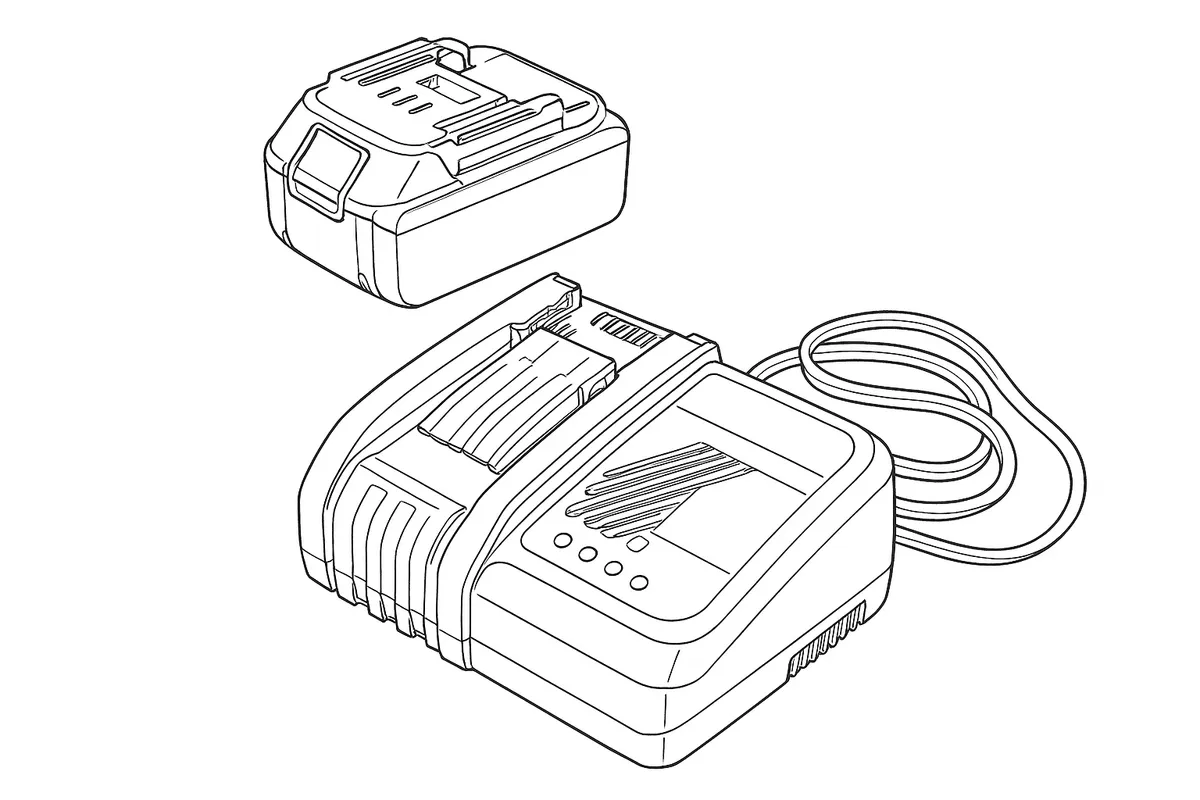
The symptom pattern
The battery clicks into the DC18RC as normal, but instead of settling to a steady red charging light the two lamps alternate — red, green, red, green — and nothing happens. Leaving it on the bench for an hour changes nothing. The same battery may have charged perfectly the week before.
That alternating pattern is not a general “something is wrong” signal. Makita assigns it one specific meaning in the DC18RC manual: charging is not possible. It is worth being precise about which light you are actually looking at, because the DC18RC uses several patterns and they mean very different things.
Reading the lights correctly
A green flash repeating on its own, with no battery fitted, is the charger idling and ready. A steady red is charging in progress; red changing to green with a melody or a long beep is charging complete.
A red light flashing by itself is a delay, not a fault. Makita lists the conditions: a battery straight off a tool, one left in direct sunlight, or one left somewhere cold. When the cartridge is too hot the charger runs its internal fan and starts charging once the pack has come down to a temperature it can work at. Waiting is the correct response.
A flashing yellow light is separate again — it warns of trouble with the cooling fan, or of a battery that has not cooled properly because something is clogged with dust. Makita notes the battery can still be charged with that light showing, just more slowly, but also says a charger whose yellow light flashes frequently should be sent for repair or maintenance.
Alternating red and green is the only pattern that means the charger has looked at the pack and refused it.
Working through it
Makita gives two causes for that refusal, and they are worth taking in order because one of them costs nothing.
The first is contamination. The terminals in the charger throat and on the battery are exposed slots that spend their life in workshop dust, and on site they collect brick dust, plaster and fine metal swarf. Unplug the charger from the mains before you go anywhere near them — the manual is explicit that the charger should be unplugged before any cleaning — and look into both sets of contacts in good light. Clear anything you find with a dry brush or a blast of air. Nothing metallic, and nothing wet.
The second cause is a battery that is worn out or damaged, and the way to separate that from a charger fault is to swap. Put a battery you know is good into the same charger. If it charges, the charger is working and the original pack is the problem. Then, if you can, put the suspect pack into a different charger; if it is refused there too, the cartridge is confirmed as the failed part.
Before condemning either, check the room. Makita specifies charging between 10°C and 40°C ambient, and says charging may not start at all with the battery below 0°C. A pack brought in from a cold van in January is a common false alarm.
The fix
Cleaned terminals are the outcome to hope for: no parts, no cost, and the charger goes back to normal immediately.
If the swap test points at the battery, there is nothing to repair. Li-ion packs fail through cell degradation and protection-circuit faults, and a charger that refuses the pack is doing its job. The pack is the part to replace.
If a known-good battery is also refused, the charger has failed.
Verdict
Worth five minutes before it is worth any money — the terminal check is free and it resolves a fair share of these.
Beyond that, the honest answer is that neither a DC18RC nor an LXT battery is a sensible repair job for an owner: both are sealed assemblies where the failed component is the expensive part of the thing. The useful work is the diagnosis, because it tells you which of the two to buy. Price both before you commit — on 18V LXT kit a replacement battery usually costs more than a replacement charger, so a fault that turns out to be the charger is the better outcome of the two.
Comments & Corrections
No comments yet. Had this fault yourself, or found something different? Tell us below.
Thanks — your comment has been sent for review. Comments are checked by a human before they appear, so expect a delay.