The symptom pattern
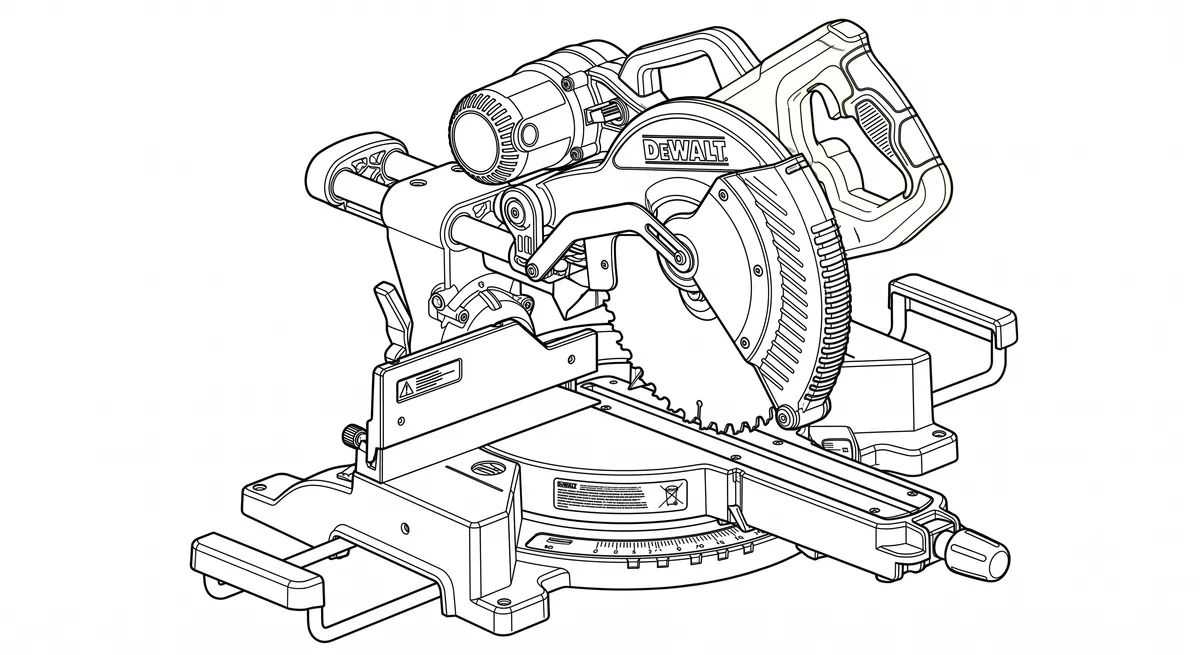
Skirting mitres that won’t close, boxes with gappy corners, and a try square that rocks against a supposedly 90° cut. The saw clicks into its detents with a confident thunk, the scales all read zero, and the cuts still come out wrong. Site saws like the DWS774 that live in a van are especially prone — every journey is a small recalibration event.
What’s actually happening
A mitre saw is only as accurate as the relationship between three things: the blade, the fence, and the table. The scales and detents are just labels attached to that geometry, and they’re adjustable precisely because they drift. A knock in transit shifts the fence a fraction of a degree; dust compacts behind the fence faces and pushes the workpiece subtly out of parallel; the detent plate wears and the “click” lands a hair off. None of it is damage — it’s maintenance that hasn’t happened yet.
The blade earns a mention too: a blade that’s picked up a bend, or carries a one-sided coat of resin, cuts wider than its geometry and can add a lean that no amount of fence adjustment removes. Always check the blade before adjusting the saw to compensate for it.
Working through it
Clean first, measure second, adjust third. With the saw unplugged, clear the dust from behind the fence, out of the detent plate, and off the table. Then measure against the blade body, never the teeth — teeth have set, and a square held on them lies. Fence square to blade at 0° mitre; table square to blade at 0° bevel; both checked with a decent engineer’s square and a strong light behind the gap.
Adjust using the fence bolts and bevel stop screws exactly as the manual sequence describes, then verify with the flip test: one cut through wide scrap, flip one piece, butt the ends. Because the flip doubles any error, a joint that closes perfectly is proof the saw is genuinely square — it’s a more sensitive test than any square you own.
Verdict
No parts, no cost — half an hour of methodical adjustment. Check it when the saw is new (factory settings are a starting point, not a promise), and re-check after any transport or knock. A mitre saw that’s trusted but never verified is how whole rooms of trim end up almost right.
Comments & Corrections
No comments yet. Had this fault yourself, or found something different? Tell us below.
Thanks — your comment has been sent for review. Comments are checked by a human before they appear, so expect a delay.