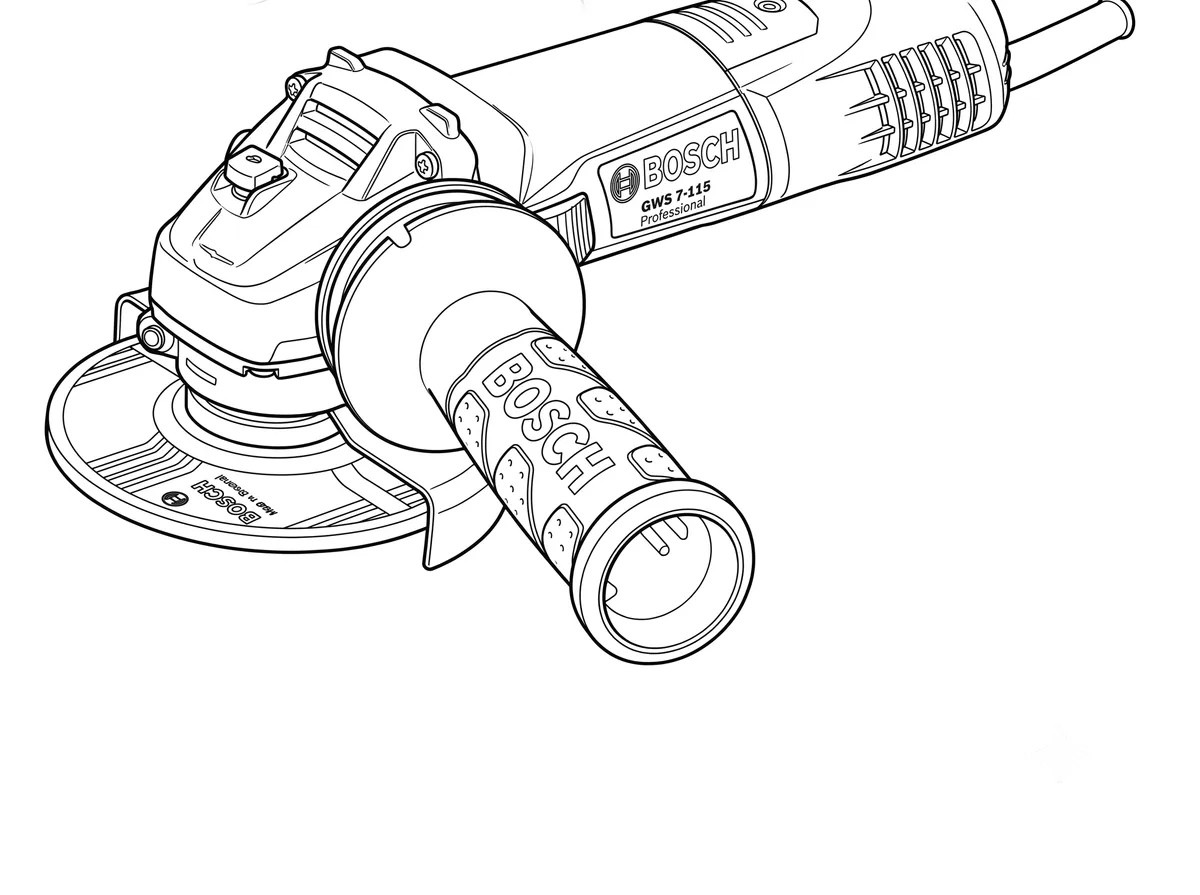
The symptom pattern
The grinder gets unreliable before it gets dead. It starts fine most days, then one morning needs the trigger cycled a few times, or a tap on the body, or starts only from certain spindle positions. Under load it may cut out for a second and come back. Eventually it won’t start at all. That slow decline is the signature of brushes reaching the end of their travel.
What’s actually happening
Like the vast majority of angle grinders, the GWS 7-115 uses a universal motor: carbon brushes press against the spinning commutator to feed current into the armature. Brushes are a designed-in consumable — they wear down millimetre by millimetre over the tool’s life. When they get short, spring pressure can no longer hold them firmly against the commutator, and contact becomes position-dependent: the motor starts from some spindle angles and not others, which is exactly what the wiggle test detects.
Some brushes include an auto-stop feature — an insert that cuts contact entirely at the wear limit — in which case the tool goes from working to stone dead without the intermittent phase.
Working through it
Check the cable before opening anything: flex the cord where it enters the tool and the plug while holding the switch on. Cord conductors break at exactly those two points and produce identical intermittent symptoms for even less money than brushes.
Inside, the diagnosis is visual: brushes worn near their limit, sticking in their holders, or with collapsed heat-blued springs condemn themselves. While they’re out, look at the commutator — an even, polished copper-to-light-brown surface is healthy; heavy blackening or grooving means the worn brushes have been arcing and the commutator may need attention too (see our Triton TPT125 entry for that diagnosis).
If the brushes come out long, springy, and free-sliding, move suspicion to the switch — the other classic wear point on grinders, and equally cheap.
Verdict
Brushes are pennies, sold as pairs, and always replaced as pairs. Run the grinder unloaded for a few minutes afterwards to bed the new faces to the commutator before grinding anything. This is the definitive first repair to learn on any brushed power tool — cheap, low-risk, and it works.
Comments & Corrections
No comments yet. Had this fault yourself, or found something different? Tell us below.
Thanks — your comment has been sent for review. Comments are checked by a human before they appear, so expect a delay.