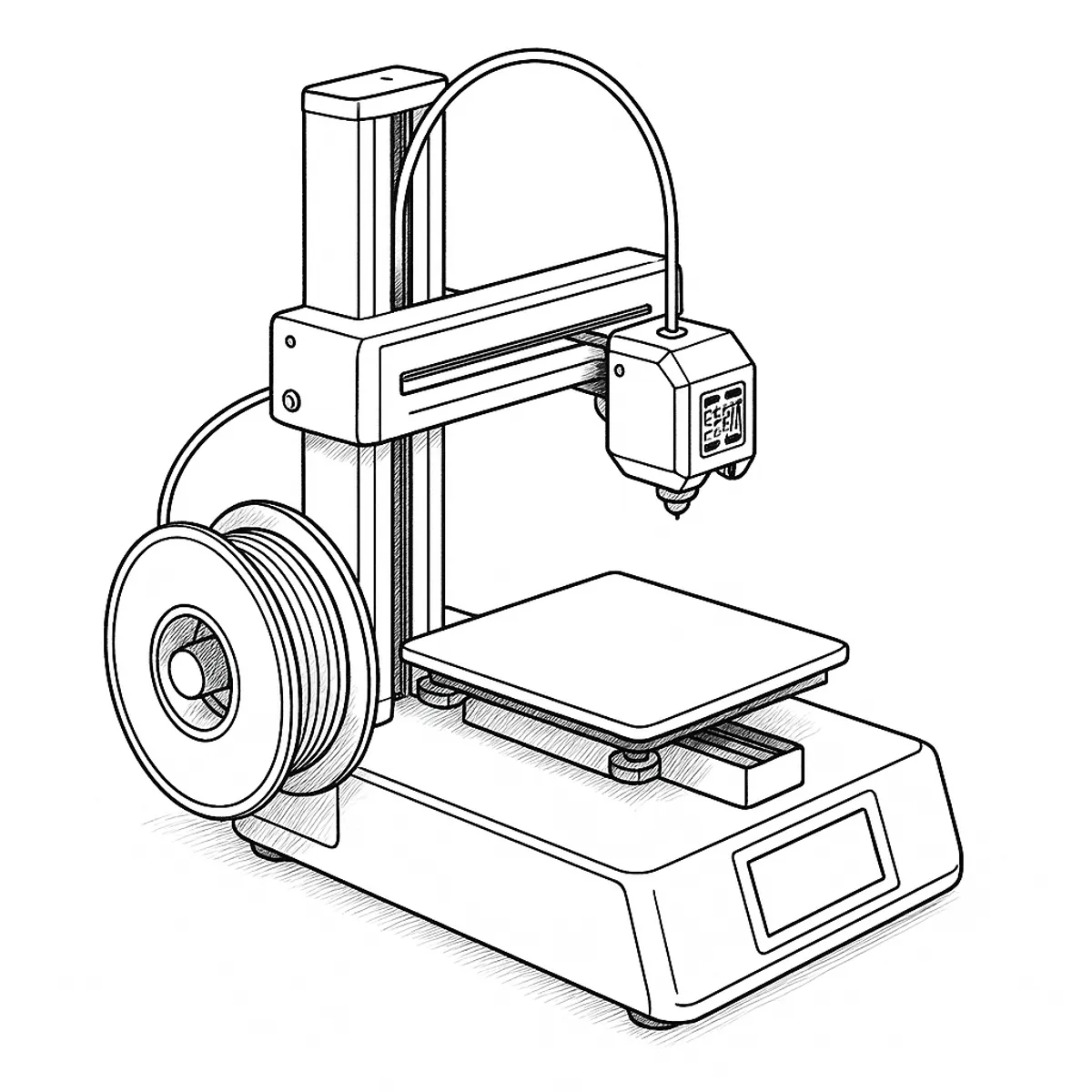
The symptom pattern
The print is running normally and then simply stops. The screen and Bambu Studio both show a variation of the nozzle temperature is abnormal, the sensor may be open circuit, tagged with the HMS code 0300-0200-0001-0007. The toolhead parks, the heaters go off, and the machine refuses to restart the job. Some owners see it appear during calibration rather than mid-print; a few see it only intermittently, clearing after a restart and then coming back a print or two later. That intermittency is a clue, and a useful one.
What’s actually happening
Nozzle temperature control on the A1 Mini rests on two components in the hotend: the heater cartridge that puts energy in, and an NTC thermistor that reports back how hot the block actually is. The toolhead board reads the NTC and modulates the heater against it.
If that sensor path opens — a broken wire, a connector no longer making contact, a failed thermistor — the board loses its only feedback. Without a credible reading it cannot know whether the block is at 20 °C or 300 °C, and a heater driven with no feedback is the failure mode that starts fires. So the firmware refuses to continue and raises the HMS code. Read that way the message is doing exactly what it should, and the machine is telling you the truth: it has lost the sensor, not that the sensor is necessarily broken.
The distinction matters because the same message appears whether the thermistor itself has died or the plug simply worked loose. Bambu Lab’s own wiki puts a loose NTC or heater connector on the toolhead board at the top of the list, ahead of a damaged sock and a physically broken sensor wire. An intermittent fault that comes and goes with toolhead movement is almost always mechanical — a connector, or a conductor fatigued at a flex point — rather than a component that has quietly failed.
Working through it
Start cold and unplugged. Get the toolhead open and look at the connectors before anything else: seat the NTC and heater plugs properly, remembering that on the V8 toolhead board the silicone sock has to come off with tweezers first. Refit the nozzle assembly while you are in there, and check the sock for splits, because a sock that has torn or gone missing changes how the block holds heat and can produce temperature complaints of its own.
If reseating does not clear it, put the printer back together, power it on without starting a job, and use the reported temperature as your instrument. Flex the loom by hand with the hotend cold and watch the number. A steady reading through the full range of movement points away from the wiring; a reading that drops out points straight at it.
The multimeter check is the one that settles it, and the sensor is the half that matters. The A1 Mini’s nozzle sensor is a 100 kΩ NTC, so unplugged and at room temperature a healthy one reads somewhere near 100 kΩ. An NTC reading open circuit has genuinely failed, or its lead has parted somewhere you cannot see — and that is the reading this error is describing.
Don’t chase an exact figure on the heater cartridge. A working one reads a low resistance; what you are looking for is open circuit or a dead short, not a target number.
Verdict
Check the connector before you buy anything. A large share of these come down to a plug that was never quite home, and that fix costs nothing but an hour of care. Where the sensor really has failed, the A1 Mini’s hotend is designed to be swapped by the owner and the part is inexpensive relative to the printer — a straightforward repair, not a reason to think the machine is unreliable.
Comments & Corrections
No comments yet. Had this fault yourself, or found something different? Tell us below.
Thanks — your comment has been sent for review. Comments are checked by a human before they appear, so expect a delay.